
Finding Waipahu Residents by Record
Waipahu grew up around sugar. Its records now sit with county and state offices rather than one town hall. A search here moves from parcel to people. Honolulu's real property assessment search turns an address or Tax Map Key into an owner of record. The county map viewer places the lot in context. The state's Bureau of Conveyances indexes every recorded deed by party name. The First Circuit's cases run through the eCourt portal. For plantation-era households, the Waipahu library and the State Archives hold old directories and local collections. A Waipahu residents directory search, in short, blends screen work with shelf work. It can help you find who lives on a street in Waipahu.
- Enter the exact site address in Honolulu qPublic and save the TMK, owner display, and retrieval date.
- Open HOLIS when the address needs to be checked against a parcel shape, nearby lots, or regulatory geography.
- Carry the name or TMK to the statewide Bureau of Conveyances index and distinguish deeds from mortgages or releases.
- For an older household, check the State Archives, library guides, and digitized city directories by year.
- When an existing government record is not posted, send a narrow UIPA request to the agency that keeps it.
Offices Behind Waipahu Resident Records
Waipahu itself has no municipal recorder. Recorded land instruments belong to the statewide Bureau of Conveyances. Parcel assessments sit with Honolulu RPAD, and voter services are split between the Hawaii Office of Elections and the Honolulu City Clerk. Trial court records rest with the First Circuit and the statewide Judiciary. The Department of Health issues vital certificates. Knowing each custodian matters. The wrong office cannot create or certify another office's record.
Hawaii Bureau of Conveyances
1151 Punchbowl Street, Room 120
Honolulu, HI 96813
(808) 587-0147
Honolulu Real Property Assessment
842 Bethel Street
Honolulu, HI 96813
(808) 768-3799
Honolulu Office of the City Clerk
530 South King Street, Room 100
Honolulu, HI 96813
(808) 768-3800
Waipahu Addresses in qPublic
The Honolulu qPublic search takes a site address or TMK. It returns the assessment record tied to a parcel. Its public form splits street number, street name, direction, and unit into separate fields. That split pays off when a unit number or suffix keeps a broad address search from matching. Parcel detail can include owner information and situs and mailing addresses. It may also list tax and sales history, land and building facts, exemptions, and instrument references.
Assessment data feeds the Waipahu residents directory, but it is not an occupant list. The situs address identifies the property itself. The mailing address only tells the tax office where to send correspondence. That may be another island entirely. Honolulu's disclaimer is blunt on another point: assessment data exists for tax purposes. It is not a title opinion.
| Search field | How to use it |
|---|---|
| Street Number | Enter the house number without adding the street name. |
| Street Name | Try the core name before adding a suffix. |
| Direction | Use only when the official address includes one. |
| Unit | Narrow a multi-unit parcel when supported. |
| TMK | Use the parcel key carried from a tax or map record. |
Waipahu Deeds Use a State Index
The BOC Data Search serves as the official statewide index. It covers Regular System and Land Court documents. You can search by grantor, the person transferring an interest. Or search by grantee, the person receiving it. TMK and Land Court certificate details narrow things further. Online index and image coverage starts in 1976. Anything older moves to the Bureau of Conveyances reference room. Or it goes to a written request citing a book and page, a document number, or another known reference.
Why does the deed index matter for a residents directory? A party name, recording date, document type, and parcel reference can link one transfer to the next. That builds a durable trail. The trail still does not prove who slept at the address. Mortgages, releases, liens, and easements are not deeds, and treating them as such muddies the record. BOC handles more than 344,000 documents and maps a year. So exact names and document identifiers count.
The Bureau's deed-chain FAQ lays out the older request route. It also shows the reference formats the office expects. The official guidance page shows those formats in context.
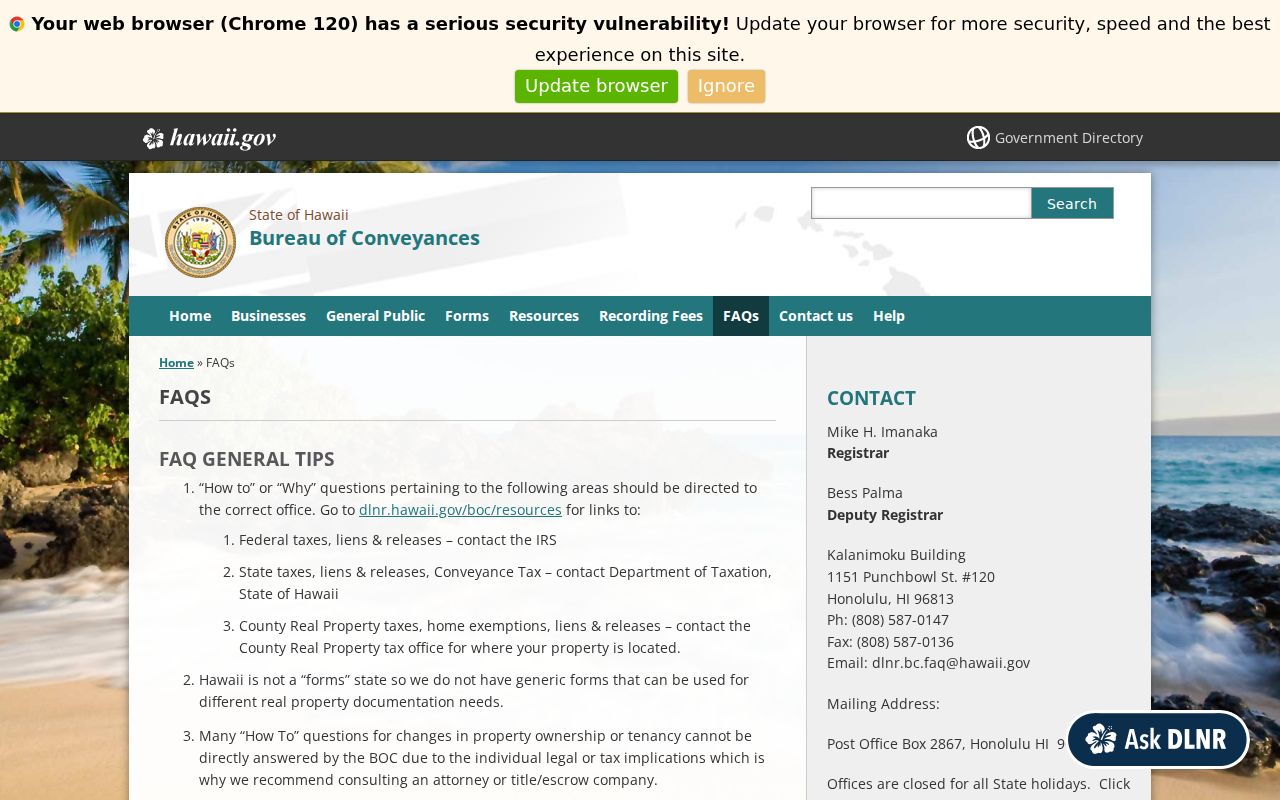
Check the cutoff and document format the custodian publishes before concluding an older Waipahu transfer is missing.
Current Waipahu Resident Record Sources
Modern directories of Waipahu residents are really a bundle of purpose-built records, each narrower than an old phone book. Property records name the owner tied to an assessment. Deeds name the parties to recorded land documents. Court indexes list parties and roles in public cases. License and business systems confirm public professional or entity roles. The official voter tool lets a voter verify and update that voter's own registration, nothing more.
| Source | Who It Lists | Keeper | Access |
|---|---|---|---|
| RPAD parcel record | Tax owner for a parcel | Honolulu RPAD | Free web search |
| BOC index | Parties to land instruments | State DLNR | Account and reference-room routes |
| eCourt Kōkua | Parties in public state cases | Hawaii Judiciary | Web index, terminals, copy request |
| MyPVL | State-licensed professionals | DCCA | Public license search |
| Business Express | Entity officers and agents in filed records | DCCA BREG | Public entity search |
Pick the source that fits the fact at hand. For one person's public trail, the Waipahu resident lookup workflow shows how to keep names, dates, addresses, and official status from blurring together.
Waipahu Voter Data Stays Narrow
Hawaii keeps its voter rolls deliberately thin. Under HRS section 11-97, the public side of a voter affidavit shows only the full name, district and precinct designation, and voter status. Everything else stays confidential unless an election or government purpose applies. No ballot choice can be inferred from registration. Party affiliation is not required to register. So the voter file is not a residents directory in any full sense.
The Online Voter Registration and Lookup is a different kind of tool. The service verifies who you are. It requires a Hawaii driver license or state ID plus the last four digits of a Social Security number. Send questions about an existing public election record to the custodian. Any request must respect the fields law keeps confidential.
Public does not mean unrestricted. Use resident records for lawful personal research and never to watch, threaten, or harass another person.
First Circuit Waipahu Case Records
Waipahu trial cases sit in the First Circuit on Oahu. The Hawaii Judiciary records hub links to eCourt Kōkua, court contacts, and access notes covering District, Circuit, and Family Court material. A docket is simply the dated list of activity in a case. A useful result can show the case ID, caption, filing type, party role, docket events, and whether a public document image exists.
A missing PDF icon proves nothing. Some documents never get imaged online. Others are sealed, and older or excluded material may take a courthouse terminal or a copy request instead. Save the case ID and exact party role first. Have both in hand before contacting the clerk. Federal cases run through PACER. Bankruptcy records for Waipahu go through the District of Hawaii Bankruptcy Court.
Waipahu Vital Records Start Statewide
Vital records in Hawaii start statewide. No Waipahu counter issues them. Birth, marriage, civil union, and death certificates all come from the Department of Health, and HRS section 338-18 demands a direct and tangible interest or another legal basis for a restricted copy.
Genealogy access covers events past 115 years. Lineage proof may still be required. It is no free preview of new events. The DOH genealogy office publishes forms and explains library microfilm and FamilySearch options. Current certificates come through online ordering, mail, or in-person service with identification and eligibility proof. Divorce duty changed on February 1, 2026, and the granting court now handles that record route.
Waipahu Records Missing Online
The Uniform Information Practices Act, written into HRS Chapter 92F, opens a route to any existing public record a portal lacks. A good request names the agency. It describes the record and its date range. Say whether inspection or a copy is wanted. The agency may segregate protected material from public material rather than deny the whole file. It need not create a new compilation.
The Office of Information Practices UIPA page carries the current rules and the request form. Ask DPP for one permit-status file tied to a TMK and period. Do not ask it to assemble every resident in a ZIP. Portal failures also have direct fallbacks. BOC offers its reference room and written requests, courts provide terminals and copies, and DPP runs its Data Access Imaging Branch.
Historical Waipahu Resident Directory Shelf
A printed Hawaii city directory can set a name beside an address, occupation, spouse, or phone listing, depending on the year. The Hawaii State Archives directory collection spans early Bennett, Husted, and Polk volumes. Selected scans route through UH Manoa eVols and Ulukau. The State Library genealogy guide adds Honolulu and island directories, obituary tools, newspapers, and vital indexes. A criss-cross directory flips the order. Entries run by street or number.
The printed shelf takes care. Early volumes may follow Honolulu or territorial coverage instead of a modern Waipahu boundary. From 1908, street indexes can lead from an address to an alphabetical entry. Earlier books demand a name-first search. Phone books list subscribers, not whole households. The full Waipahu city directory collection lays out the years, publishers, and reading method without turning a historical entry into a claim about current residence.
- Parcel
- A mapped piece of land identified for tax and record purposes.
- Index
- A finding aid that points to a record; it is not always the record image.
- Roll
- A maintained list created for one official purpose, such as assessment.
- Criss-cross directory
- A directory arranged by address or phone rather than by surname.
Waipahu Sugar Records Add Names
Oahu Sugar Company papers tie Waipahu to its plantation days. The collection spans payroll ledgers, mill logs, railroad files, camp rolls, maps, and community records. The company ran from 1897 to 1995. These files are not a modern residents directory. Yet they often explain why one archive holds a family name that a city directory misses. The UH collection description and the Digital Archives of Hawaii are good starting points. Each offers the finding aid and open images.
Old place labels matter here. A record may list Waikele, Waipio, a plantation camp, the mill, or a railroad stop. A present-day lookup expects Waipahu instead. Keep the old wording. Set it beside the current parcel or road name rather than erasing it. For questions that resist an online search, the Hawaiian Historical Society library maintains an appointment research room, a catalog, microfilm, and paid research help. Its official library page describes those services in detail.

A broad request for everyone with a surname will stall. Catalog terms, dates, and collection identifiers give staff something precise to pull.
Waipahu ZIP and Parcel Boundaries
Waipahu shows up on several maps at once. The USPS treats the city name as a delivery label, not a place. The Census CDP is a statistical construct. ZIP 96797, Neighborhood Board 22, election precincts, and TMK parcels all carve the same ground. Each layer draws its own lines. HOLIS maps parcels and regulatory layers. Voter rolls instead use district and precinct codes. So one name can sit in two systems under two geographies. Historic routing tables even grouped 96707 and 96709 under Waipahu processing. That never made those places part of physical Waipahu.
Record each address exactly as its source shows it, and note when you pulled it. Validate mail through USPS. Confirm the site address in RPAD. Then use HOLIS for mapped context. That way a simple ZIP match never becomes a false claim. A parcel or person may not sit inside the Waipahu CDP.
Protecting a Waipahu Address
Some resident records are closed on purpose. Hawaii's Address Confidentiality Program gives eligible survivors of domestic abuse, sexual offenses, or stalking a substitute address. Vital certificates require statutory eligibility. Most fields on a voter affidavit are confidential. Federal law restricts motor vehicle record disclosure too. A Waipahu resident lookup should stop the moment a source demands identity, consent, or a legal entitlement the requester does not hold.
Official indexes and commercial people-finders are not equals. A real records office names its custodian, its purpose, its field definitions, and its correction route. A commercial compilation may merge stale addresses, namesakes, and copied entries without showing any source date. Use the least personal data needed, verify through the custodian, and report threats or stalking to law enforcement.
| Source type | Strength | Main limit |
|---|---|---|
| Official current index | Named custodian and defined purpose | May omit protected or nonpublic fields |
| Archive or directory | Dated evidence for family and place history | May use old labels and list only subscribers |
| Commercial compilation | May point toward a possible lead | Source age and identity matching may be unclear |